
Fuel pump management for fleets with their own diesel depot
Run your own diesel pump like a controlled store — tanker receipts checked against the dip, every fill issued to a vehicle with odometer and meter reading, live tank stock with low-level alerts, shift reconciliation, and theft flagged against GPS km and km/litre benchmarks. Own-pump and outside-station fuel on one ledger, posted to vehicle cost and accounts, for fleets in Bangladesh.

Use cases
- Company diesel depot issuing fuel to trucks, buses, and pickups with a signed record per fill.
- Tanker deliveries checked against dip readings so short-delivery is caught before the supplier is paid.
- Factory or plant site tank feeding vehicles, generators, and heavy equipment from one stock.
- Multi-branch fleets with a pump per depot, each with its own attendant, stock, and report.
- Mixed fleets using an own pump plus outside stations — one cost per vehicle across both.
- Owner or audit review — monthly stock movement, variance, and km/litre per vehicle on one report.
- Retail pump shifts where cash, credit customers, own vehicles, expenses, and old-due collections must reconcile to one drawer.
- Fuel and lubricant sales where product stock, purchase cost, margin, and profit need separate control.
Why you need this
- Issue slips and a paper log book are easy to edit and impossible to audit.
- Dispenser meter readings are never reconciled with the issue log or the tank dip.
- Nobody knows live tank stock — reorder is a guess and a dry tank stops the fleet.
- Tanker short-delivery goes unchecked and the supplier is paid for litres never received.
- Fuel written against one vehicle and poured into another — without an odometer there is no proof.
- Own-pump and outside fuel in separate books means no single cost per vehicle or km/litre truth.
- Cash, credit sales, company use, expenses, and old dues are mixed together, so the operator drawer never matches.
- Month-end profit is rebuilt in spreadsheets because fuel cost, lubricant margin, and pump expenses live in different books.
Key modules
Typical workflows
- Purchase order → tanker arrives → dip before → unload → dip after → receipt vs challan check → stock up → supplier bill.
- Operator login → opening nozzle metres → opening cash float → cash, credit, and own-fleet sales → closing metres → counted cash → shortage or excess.
- Quick sale → receipt → nozzle metre movement → mapped tank stock reduction → cash, receivable, or internal vehicle-cost posting.
- Metre movement → less measured test fuel → real sales → stock movement → physical dip → litre variance investigation.
- Credit issue → customer receivable → later collection → drawer cash increase without counting the collection as a new sale.
- Daily statement → shift review → stock and dues reports → monthly expenses → monthly statement → true profit and loss.
Set up the whole pump once — then run every shift the same way
Build the operating structure before the first sale. Rates, tanks, nozzles, cash accounts, opening stock, customers, company vehicles, and staff responsibility all start from one controlled setup.
Buying & selling rates
Keep purchase and selling rates for diesel, octane, and lubricants. A new government rate applies from the next shift without rewriting old sales.
Tank register
Create every underground or above-ground tank with fuel type, capacity, and its own independent stock balance.
Nozzle-to-tank mapping
Map each numbered nozzle to the tank it draws from, so every metre movement reduces the correct physical stock.
Opening balances
Start with actual nozzle metres, litres and valuation per tank, cash and bank balances, and customer receivables.
Staff & cash drawers
Give each pump manager a login, role, and drawer account — every sale and shortage remains tied to the responsible shift.
Customers & own vehicles
Maintain credit customers and company vehicles separately so receivables, income, and internal fleet cost never get mixed.
Where an own fuel pump quietly leaks money
A company diesel tank looks cheap until you count it — tanker receipts on paper, dispenser meter readings in a notebook, and fills written against the wrong vehicle. The gap between litres bought and litres used is found at month-end, if at all.
Register on paper
Issue slips and a handwritten log book — easy to edit, impossible to audit.
Meter not reconciled
Dispenser totaliser and the issue log never compared, so short-issue and over-issue hide in the gap.
Tank stock unknown
Nobody knows the live litres in the tank — reorder is a guess and a dry tank stops the fleet.
Tanker short-delivery
Delivery challan says 4,000 L; the dip says less — without a receipt check, the supplier is paid in full.
Fill to the wrong vehicle
Fuel written against one truck, poured into another — or into a jerry can — with no odometer to catch it.
Outside pumps separate
Station vouchers and own-pump issues in two books — no single cost per vehicle, no km/litre truth.

A complete shift — opening metre to cash handover
A shift is one operator's period of responsibility. Opening metres, sales, expenses, collections, closing metres, and counted cash stay together, so the handover has a number behind it.
Open the shift
Select the operator, enter the exact visible metre for every nozzle, and record the opening cash float.
Sell & print
Choose a nozzle, enter litres or taka, select cash, credit, or own vehicle, then save and print the receipt.
Record everything moving
Fuel receipts, pump expenses, old-due collections, and test fuel are posted during the shift — not reconstructed at night.
Enter closing metres
The system calculates metre movement per nozzle and removes measured test fuel before deriving real sales.
Count the drawer
Expected cash excludes credit and own-fleet fuel, deducts pump expenses, and adds old receivables collected today.
Close with variance
Counted cash is compared with expected cash. Short or excess is shown clearly and retained against the shift.
One sale updates sales, stock, and accounts together
There is no second stock book and no separate cash entry. A saved slip advances the nozzle, reduces its mapped tank, and posts the correct money movement in one transaction.
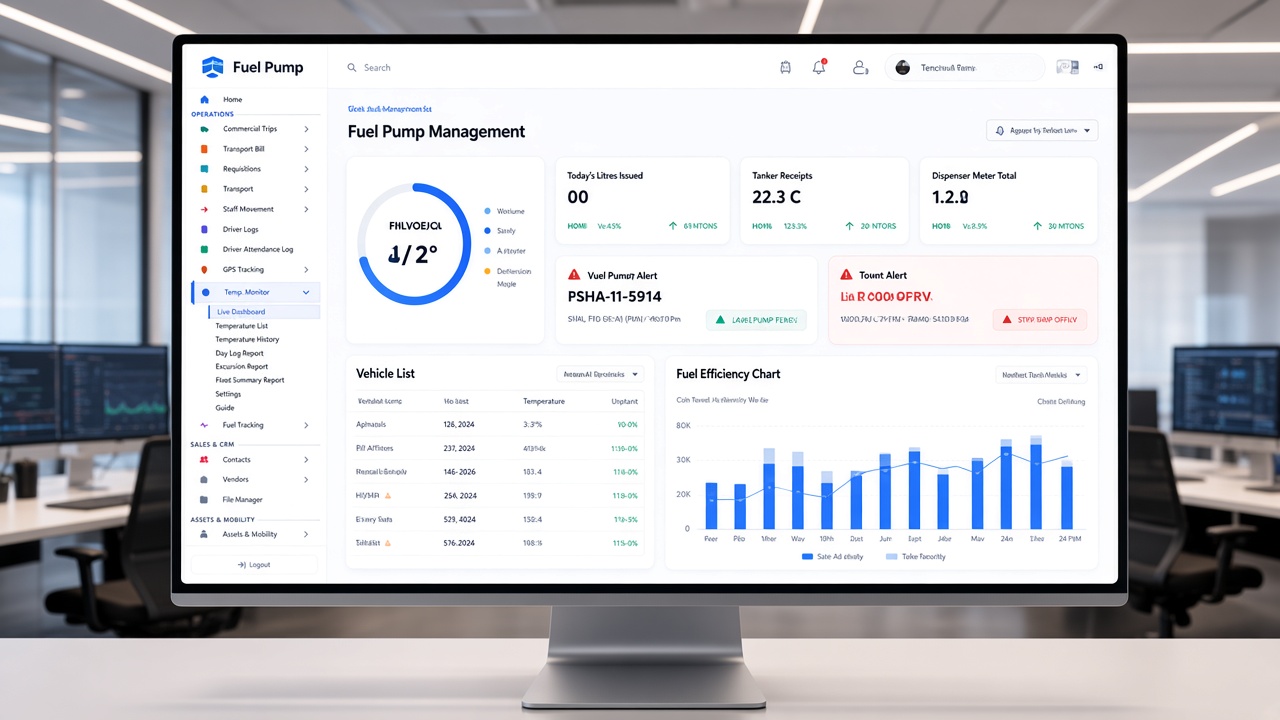
Quick sale desk
Sell by litres or by taka from a fast counter screen, with the active rate and selected nozzle applied automatically.
Printable receipt
Produce a clean receipt for cash, credit, or fleet issue without handwriting another duplicate slip.
Automatic stock posting
The sold quantity leaves the exact tank mapped to that nozzle; no separate issue journal is required.
Automatic accounting
Cash goes to the operator drawer, credit to customer receivable, and company-vehicle fuel to internal expense.
Void, never erase
A wrong slip is voided instead of deleted — removed from totals but retained in the audit trail.
Rate history preserved
Price changes affect new shifts while previous sales keep the rate that was valid when they were posted.
Physical fuel control — tanker, tank, nozzle, and dip
Book stock is continuously built from opening litres, receipts, measured sales, test fuel, and allowances. A physical dip then exposes leakage, delivery shortage, or an unposted movement.
Fuel receipt by challan
Post litres, purchase rate, delivery challan, and destination tank as soon as the tanker unloads.
Metre-based truth
Shift sales come from closing metre minus opening metre — the dispenser totaliser remains the control number.
Test fuel treatment
Nozzle test litres are removed from metre sales and returned to the tank, so they become neither sale nor stock loss.
Dip verification
Enter the physical litres found by dip and see the difference from system stock immediately.
Allowance tracking
Configured operating allowance is shown in the stock report instead of disappearing inside unexplained variance.
Shortage investigation
Trace a mismatch back through receipts, nozzle movement, test fuel, and shifts before approving an adjustment.

Cash, credit, own-fleet use, and expenses stay separate
The same nozzle can serve several commercial outcomes without corrupting the drawer. Every payment type follows its own accounting rule and still reduces physical fuel correctly.
Cash sale
Fuel value increases the operator's expected drawer balance for the current shift.
Credit customer
Fuel becomes customer receivable and is excluded from cash expected today.
Company vehicle
Internal refuelling becomes company vehicle cost — not pump revenue and not drawer cash.
Old due collected
A receivable payment increases today's cash without being counted again as today's sale.
Pump expense
Electricity, repairs, refreshments, and other configured heads reduce the selected cash account transparently.
Expected vs counted
Closing shows the exact cash expected, the cash physically counted, and the operator's shortage or excess.
Lubricants and non-fuel items — controlled beside the pump
Engine oil and lubricant trading has a different stock and margin pattern from dispenser fuel. Keep product purchases, quantities, sales, and profit visible without mixing them into tank litres.
Product catalogue
Maintain lubricant products and pack sizes as stock items separate from tank fuel.
Lubricant purchase
Record product, quantity, and purchase rate whenever new stock arrives.
Counter sale
Sell lubricant from the same operating system while preserving its own quantity and value.
Separate margin
See lubricant income and cost independently in monthly accounts and profit calculations.
Consistent expense heads
Configure standard expense categories so monthly comparisons do not fragment under different names.
Deactivate, do not delete
Retire used tanks, nozzles, products, or expense heads without breaking historical reports.
Owner reports — from today's drawer to true monthly profit
Every report answers a specific operating question. Print the daily statement, inspect a salesperson, verify tank stock, chase dues, or close the month without rebuilding figures in spreadsheets.
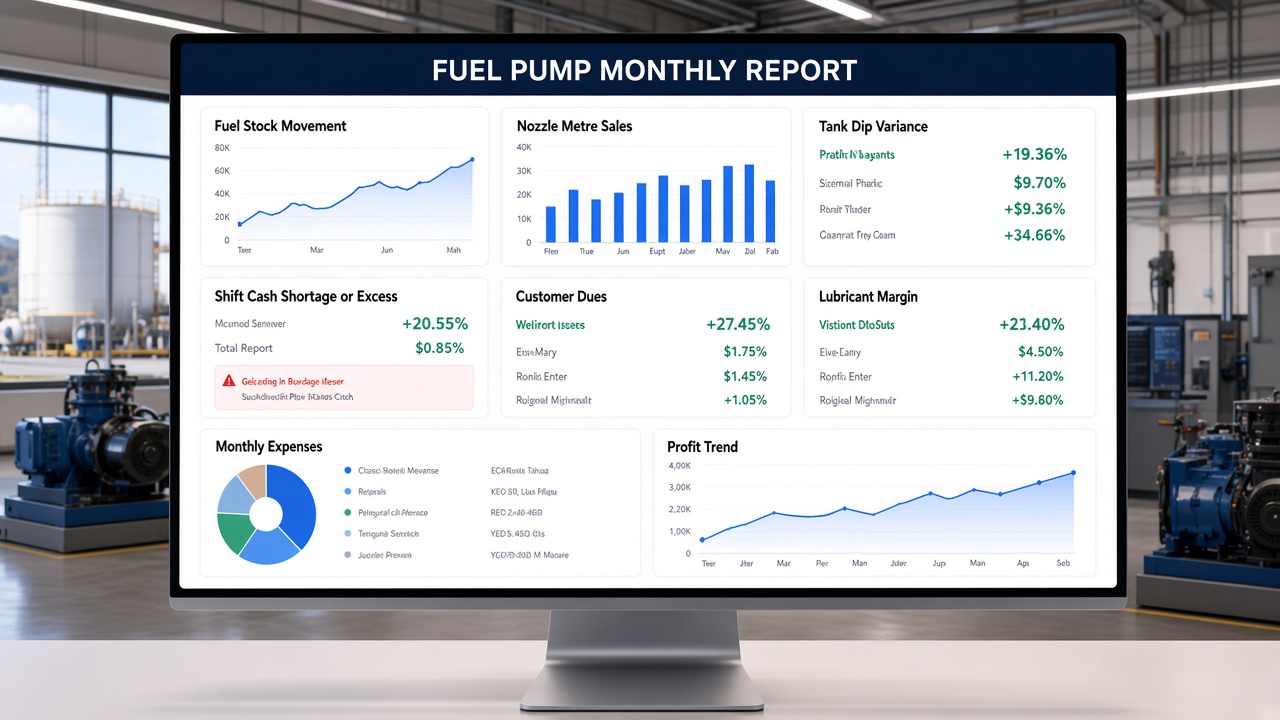
Daily statement
One printable page for metres, sales, credit, expenses, cash, receipts, and closing stock.
Shift report
Sales, deposits, and shortage or excess for each operator and duty period.
Sales report
Quantity and value by date range and fuel type, with historical rates retained.
Stock report
Opening, purchases, sales, tests, allowance, closing litres, physical dip, and variance.
Customer dues
Outstanding balance by customer with sales and collection history.
Monthly expenses
Days as rows and expense heads as columns — the whole month on one sheet.
Monthly statement
Fuel and lubricant income, operating costs, and the resulting month-end position.
Profit & loss
Sales less purchase cost and pump expenses, showing the actual operating profit.
Controls that keep the numbers trustworthy
The system prevents common shortcuts that make pump books impossible to audit. Corrections remain visible, active shifts protect metre values, and every handover starts from a physical reading.
Metres lock during a shift
Opening balances cannot rewrite a nozzle while that nozzle belongs to an active shift.
Short/excess stays visible
Cash variance is surfaced at close instead of being silently adjusted away.
Role accountability
Sales and drawer movements remain linked to the logged-in pump manager.
Independent handover
The next operator opens a new shift with a fresh observed metre — closing one shift never auto-opens another.
Reversible corrections
Void a bad slip and preserve evidence; deactivate used setup records instead of deleting history.
Print-ready audit pack
Daily, shift, stock, dues, monthly, and profit reports are ready for owner review or accounts filing.
Who runs on it — and the modules behind it
Fuel pump management sits inside Autonemo VMS Pro: the tank is connected to trips, GPS, garage, drivers, and accounts — one system for the whole fleet.
Trucking & logistics
Own diesel depot for a haulage fleet — issue per trip with km/litre per truck and route.
Factory & plant sites
Site tank feeding trucks, generators, and heavy equipment with an issue log per asset.
Bus & staff transport
Depot pump for a bus fleet — fill before duty, reconciled at shift close.
Multi-branch depots
A pump per branch with its own stock, attendant, and report — rolled up for head office.
Full fleet suite
Trips, live GPS, garage job cards, drivers, and documents — all linked to the same vehicle.
Accounts & audit
Fuel stock valued in double-entry accounts with an audit-ready issue and variance export.