
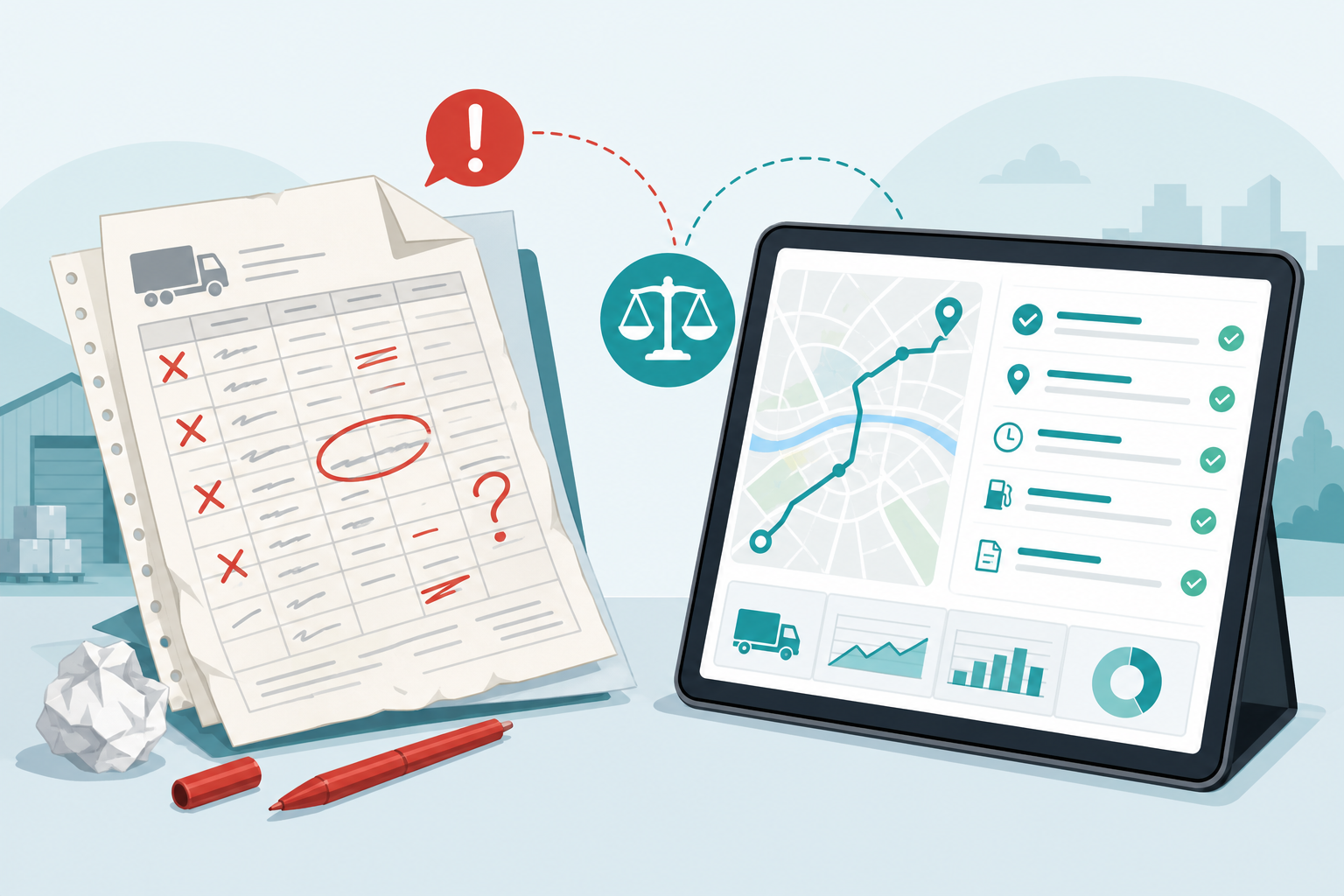
Trip sheets remain the billing backbone for thousands of Bangladesh logistics operators — from inter-city cargo movers to dedicated corporate shuttles. Even fleets with GPS often invoice from paper or spreadsheet summaries that drivers submit days late. Small errors on each sheet repeat weekly and compound into lakhs of lost margin, delayed cash collection, and client relationships damaged by disputes that both sides know were preventable.
The problem is rarely dishonesty alone. Manual km entries drift from reality when route lists age, multi-stop deliveries collapse into point-to-point billing, and duplicate sheets appear because no unique trip ID governs the chain from requisition to invoice. Finance discovers errors weeks later; operations has moved on; recovery is argumentative.
Fixing trip sheet discipline is less about perfect drivers and more about one governed record from dispatch through close — with GPS distance bands as verification, not replacement for operational context.
Commercial officers and finance leads should join one monthly trip-sheet audit — ten random closed trips reviewed for field completeness, km variance, and document match. Cross-functional review prevents operations blaming drivers while finance discovers billing gaps weeks later. The audit takes ninety minutes and pays for itself the first time it catches a duplicate vendor trip.
Wrong distance or route recorded
Drivers rounding km to the nearest ten, using outdated route master lists, or copying yesterday’s distance for a similar lane creates systematic under- or over-billing. Clients with their own GPS audits will catch underbilling eventually — and overbilling erodes trust immediately.
Tie trip completion to approved route master with GPS distance band comparison at close. Variances beyond threshold require reason code before billing release — not optional notes in margins.
- Maintain route master with approved km bands updated quarterly
- Compare claimed km to GPS band at trip close, not at invoice
- Require reason codes for deviations above agreed percentage
Missing pickup or delivery stops on multi-stop trips
Multi-stop urban delivery billed as single point-to-point undercharges when extra stops were served but not logged — or overcharges when stops were planned but skipped without record. Stop count, sequence, and proof should be explicit on every sheet and in the digital trip record.
FMCG and pharma clients increasingly audit stop-level proof. A missing stop line item is a contract failure even when total cartons delivered match order.
Duplicate or overlapping trip records
Same vehicle logged twice on one day, or two sheets for one physical movement, produces invoice fights that consume commercial team hours. Unique trip IDs issued at requisition or approval prevent duplication at source — retroactive deduplication in finance is expensive detective work.
Vendor-hired trips parallel-tracked on WhatsApp and formal register duplicate more often than owned fleet because no single dispatch queue governs both.
Late submission blocks invoicing and cash flow
Finance cannot bill what operations has not closed. Trip sheets submitted three days after completion delay invoice generation, push receivables rightward, and hide operational problems until the month is already lost. Same-day or next-morning close rules are non-negotiable for commercial lanes.
Billing speed is competitive advantage in contract transport — clients notice which operators produce proof and invoice within 24 hours of delivery completion.
Allowances detached from trip type and route class
Driver food, toll, overnight, and helper allowances differ by route category. When allowances float free of trip type, cost allocation breaks — route profitability reports lie, and payroll disputes multiply. Encode allowance rules in trip category master, not in dispatcher memory.
Audit random weeks for allowance paid without matching trip class; leakage often concentrates on familiar lanes everyone assumes are correct.
Build one chain from requisition to invoice
Requisition, approval, assignment, live follow-up, completion proof, and billing release should reference one trip record. Paper at the edges — signed delivery notes, gate passes — is acceptable; broken handoffs between departments are not.
Each handoff owner should see only the queue relevant to their role, but leadership must see the full chain for dispute resolution and client QBRs.
Building trip-sheet discipline across departments
Operations owns timely close; finance owns billing release rules; commercial owns client-facing km disputes. Monthly ninety-minute joint audit of ten random trips keeps all three aligned — no department optimises locally at others’ expense. Reward branches that achieve highest same-day close rate; publish branch comparison without shaming individuals.
Train new drivers on trip close checklist during onboarding, not after first billing dispute. Helpers on multi-stop routes need same training on stop logging — missing stop often originates at helper level while driver focuses on driving.
Common mistakes to avoid
Blaming GPS when billing still runs on uncorrected manual sheets wastes technology investment. Teams also implement digital trip records but allow parallel WhatsApp dispatch — dual systems guarantee the errors digitalisation was meant to eliminate.
Do not let commercial officers override closed km without audit trail; exceptions happen, but undocumented overrides train drivers to inflate distances. Avoid closing trips without document checklist — arrival time without signed proof is incomplete close.
Quick action checklist
- Issue unique trip ID at requisition or approval — no exceptions
- Update route master km bands and communicate changes to dispatch
- Log every stop on multi-stop trips with sequence and proof status
- Enforce same-day or next-morning trip close for commercial lanes
- Link allowances to trip category automatically where possible
- Compare claimed km to GPS band before billing release
- Run weekly sample audit of ten closed trips for field completeness
Learn how operators reduced billing disputes and accelerated cash collection in our case studies. See trip-to-invoice flow in a live demo or explore commercial transport modules on the logistics solutions page.